The behavior of frontal barriers is subject to evaluation by those tasked with selecting them for road use. The tests conducted on these systems involve frontal, angled, and lateral impacts. The way the barrier reacts allows for the classification of the tested system.
In the classification of restraint devices, the characteristics “gating/non-gating” and “redirective/non-redirective” are used to outline the behavior of a crash cushion or barrier terminal. The standards involved are EN 1317 and MASH 2016, which employ the distinction between “redirective” and “non-redirective.”
Redirective vs. Non-Redirective
“Redirectivity” is the ability of a device to contain the impact of a vehicle and guide it back onto the roadway, while a non-redirective device has not demonstrated such behavior in the event of a lateral impact.
According to the American MASH 2016 standard, a crash test for non-redirective devices is also required to understand their behavior.
Below is an excerpt from the MASH standard referencing evaluation criteria for lateral impacts: “Note that non-redirective crash cushions are not designed to safely mitigate this type of impact and, therefore, occupant risk parameters are not among the recommended assessment criteria. However, these values should be reported as a tool to enable user agencies to estimate the potential risk of using non-redirective crash cushions. Impacting vehicles must remain stable and upright during the test.”
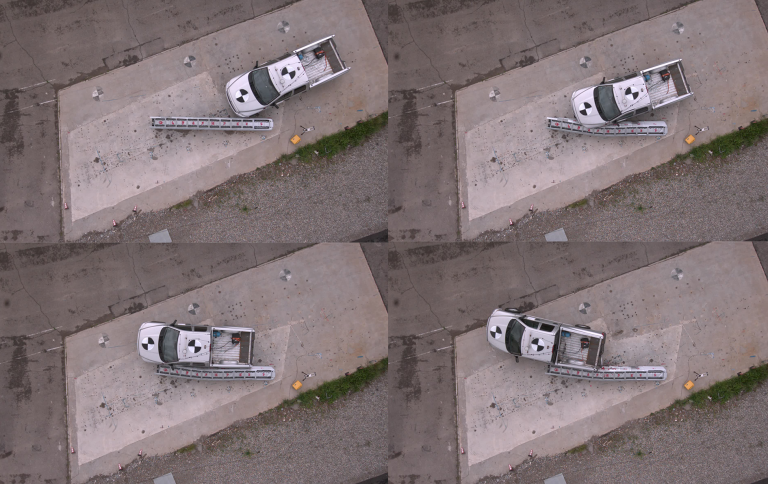
Sequence of impacts that redirect the Hercules vehicle.
Gating vs. Non-Gating
The MASH standard further differentiates crash cushions and barrier terminals into “gating” and “non-gating” devices. The literal meaning of “gating” is a “gate device” (from “gate”), referring to a device designed to allow a moving vehicle to pass through the barrier during impact and enter a “clear zone.”
Concept of Clear Zone
A “clear zone” is an obstacle-free area designed for errant vehicles to stop safely, allowing the vehicle to decelerate. The size of this space is determined by the designer (e.g., for gating devices, it can be 6 meters wide and 24 meters long in some areas). Conversely, a non-gating device does not allow the vehicle to leave the roadway during impact. Non-gating devices also require a “clear zone,” but it is significantly smaller.
An example of how to calculate a clear zone for gating end terminals.
Differences Between Non-Gating and Redirective Classification
The fundamental difference lies in the crash tests performed. Specifically, Tests 32 (with a car) and 33 (with a pickup) according to the American standard determine whether the device behaves as gating or non-gating. These tests are conducted on terminals and crash cushions with a vehicle impacting the head or front of the system at a 15-degree angle.
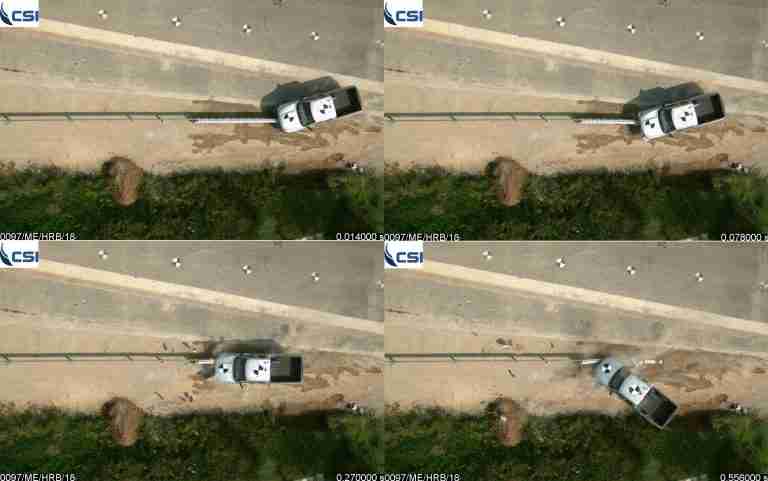
The behaviour of a non gating end terminal
Meanwhile, Tests 34 and 35, which involve a side impact on the device, determine whether a device can be classified as “redirective.” A “Critical Impact Point” (CIP) is defined as the point from which the device’s behavior can be considered non-penetrable and redirective. During MASH Test 35, a 2,270 kg vehicle is directed toward the device at the critical point with an impact angle of 25 degrees.
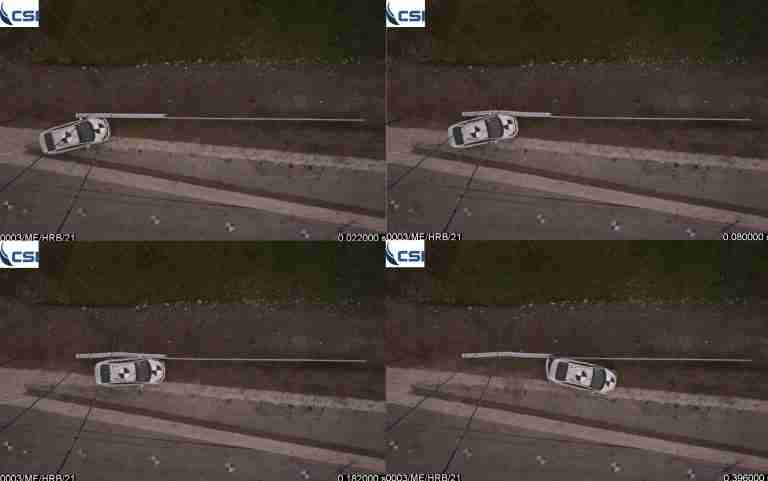
The behaviour of a redirective end terminal
Device Types
A vehicle restraint system can be:
Gating redirective
Non-gating redirective
Gating non-redirective
Non-gating non-redirective
For simplicity, we focus on the first two types and outline their differences:
Gating redirective devices (generally single-sided barrier terminals): Designed to allow a vehicle to pass through when hit near the initial end (head) and to redirect the vehicle from a specific distance from the head. The redirection point depends on the specific product’s characteristics, although many gating devices are redirective starting from the third or fourth post from the head.
Non-gating redirective terminals: Designed to contain the vehicle on the roadway along their entire length (at any point the vehicle hits the device, it is contained on the roadway). In fact, the “CIP” in non-gating systems is precisely the front end (the head), where the device’s behavior transitions from “shock absorption” to redirection.
A non-gating redirective device can be used in place of a gating redirective device, but not vice versa.
Why are non-gating systems safer?
Although EN 1317 does not require the use of non-gating devices, they are the ideal option for countries with limited space on the road network. The presence of poles, trees along the roadside, or drainage ditches necessitates a “non-penetrable” device as the only feasible solution.
Both gating and non-gating devices require a clear zone. However, while gating devices need a large stopping area for the vehicle, non-gating devices require a significantly smaller free area since they stop the vehicle on the roadway. Therefore, even in the absence of a clear zone, non-gating reduces the likelihood of a post-collision accident.
Crash cushions used in medians are non-gating because their application reduces the risk of the vehicle crossing into the opposite lane, avoiding danger to both the driver involved in the collision and other road users.
However, crash cushions have a considerably larger transverse footprint than barrier terminals. As a result, applying these devices is not always feasible on the roadside edge or in medians.
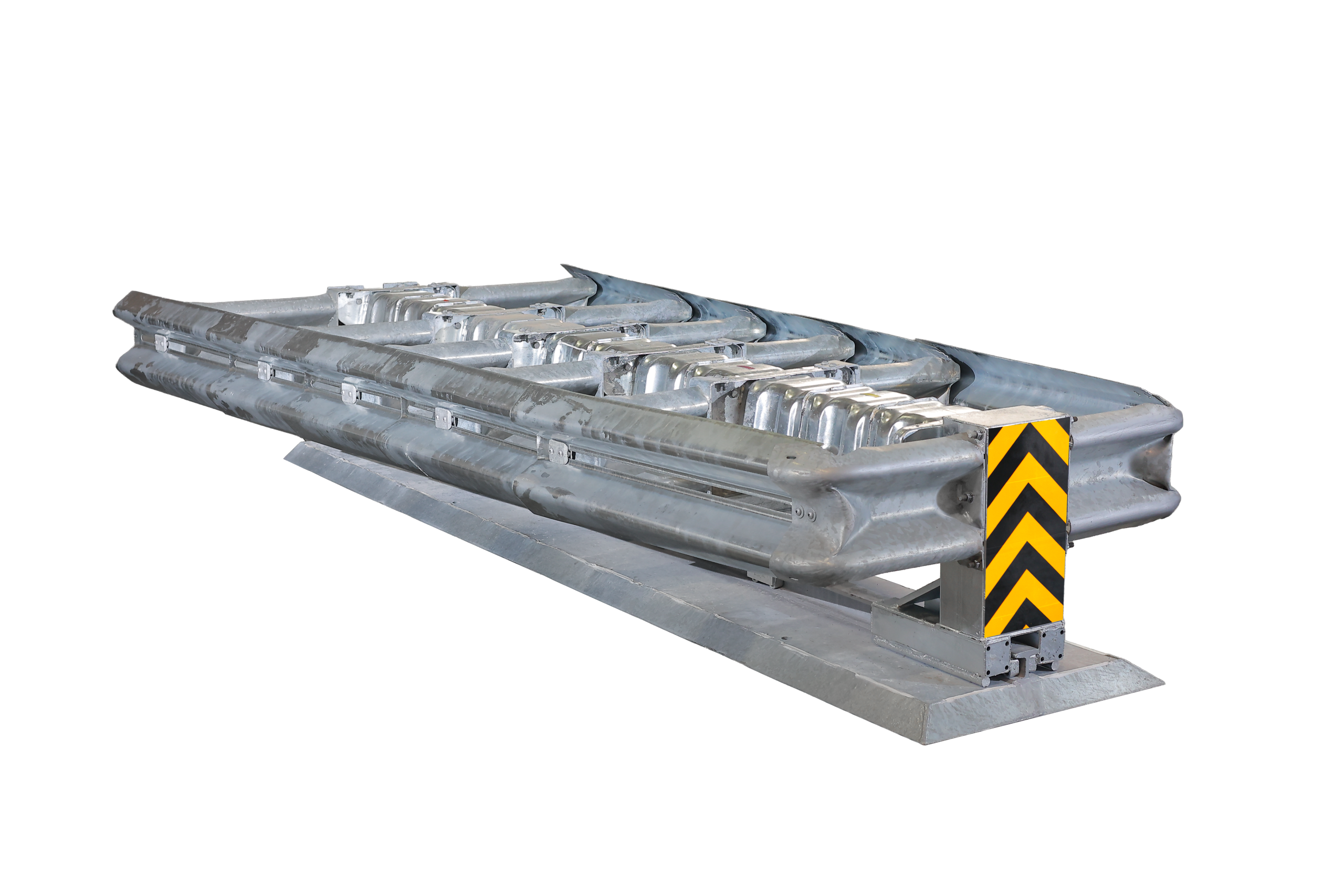
All devices supplied by SMA, both MASH- and EN 1317-tested, are non-gating redirective.
This site or third-party tools used by this make use of cookies necessary for the operation and useful for the purposes described in the cookie policy. If you want to learn more or opt out of all or some cookies, consult the cookie policy. By closing this banner, scrolling this page, clicking on a link or continuing to browse in any other way, you consent to the use of cookies.